BPVM Snack Pack #3 - Compilation Kick-Off
You hit 'Compile'. Behind that button is a 16-stage pipeline that handles dependencies, generates code, and updates live instances. Here's how it works.
TL;DR — Clicking Compile triggers FBlueprintEditor::Compile(), which queues your Blueprint into FBlueprintCompilationManager and runs FlushCompilationQueueImpl() — a 16-stage pipeline that gathers and topologically sorts dependencies, then generates UProperties, UFunctions, and bytecode in stages XII and XIII before reinstancing existing objects.
The content in this post is based on Unreal Engine 5.4.0
BPVM Snack Pack is a companion series to the deep-dive Blueprint to Bytecode series. Each snack is 3-5 minutes of pure knowledge!
The Compile Button
You click it. It turns green. Ship it!
But between that click and the green checkmark, there’s a 16-stage compilation pipeline executing in precise order. Think of it like a game’s rendering pipeline, but for code generation.
Stage 0: The Button Click
When you click “Compile”, you trigger a command from this function:
1
2
3
4
5
6
7
8
9
10
FBlueprintEditorToolbar::AddCompileToolbar()
{
    // Creates the compile button
    FToolMenuEntry& CompileButton = InSection.AddEntry(
        FToolMenuEntry::InitToolBarButton(
            Commands.Compile,  // ← This is the command
            ...
        )
    );
}
This kicks off FBlueprintEditor::Compile(), which adds your Blueprint to a compilation queue.
The Queue System
Unreal doesn’t compile Blueprints one at a time - it uses FBlueprintCompilationManager to batch them:
1
2
3
QueueForCompilation(YourBlueprint);
// ... queue up dependencies too ...
FlushCompilationQueueImpl();  // ← The real work starts here
Why batch? Same reason games batch draw calls: if Blueprint A depends on Blueprint B, and B depends on C, you need to resolve the dependency graph and process them in topological order.
The 16 Stages (High-Level)
Here’s what FlushCompilationQueueImpl() does:
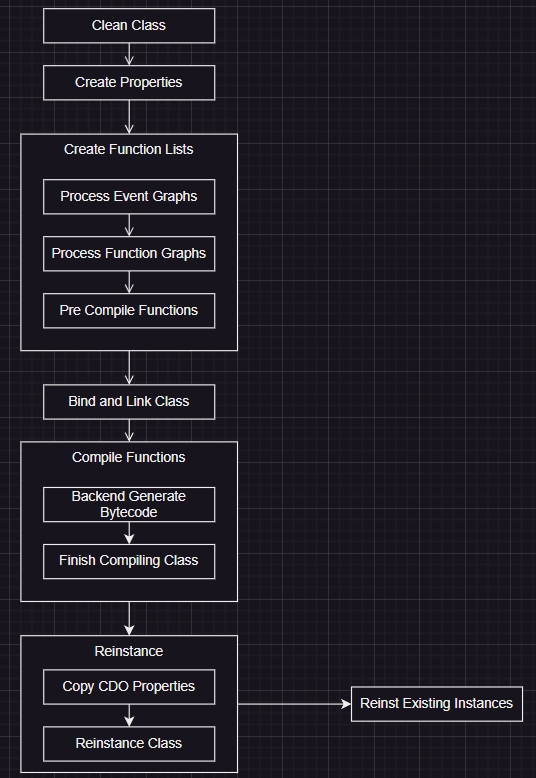
Preparation (Stages I-VII):
- GATHER - Find all dependent Blueprints
- FILTER - Remove duplicates and invalid ones
- SORT - Order by dependency (C → B → A)
- SET FLAGS - Mark as “currently compiling”
- VALIDATE - Check for errors
- PURGE - Clean up old data (load-time only)
- DISCARD SKELETON CDO - Prepare for regeneration
Compilation (Stages VIII-XIII):
- RECOMPILE SKELETON - Create class headers
- RECONSTRUCT NODES - Update deprecated nodes
- CREATE REINSTANCER - Prepare to update instances
- CREATE CLASS HIERARCHY - Link parent/child classes
- COMPILE CLASS LAYOUT - Generate properties and functions ⚡
- COMPILE CLASS FUNCTIONS - Generate bytecode ⚡⚡
Finalization (Stages XIV-XVI):
- REINSTANCE - Update all existing instances
- POST CDO COMPILED - Finalize Class Default Object
- CLEAR FLAGS - Mark as “done”
The Two Critical Stages
Stages 12 and 13 are where code generation happens:
Stage XII - COMPILE CLASS LAYOUT:
- Creates
UPropertiesfor your variables - Creates
UFunctionsfor your functions - Sets up the class structure (like generating a C++ header)
Stage XIII - COMPILE CLASS FUNCTIONS:
- Converts your nodes into intermediate statements
- Generates bytecode from those statements
- Links bytecode into the class (like compiling a .cpp file)
Why So Many Stages?
Each stage handles a specific problem:
Circular Dependencies?
- Stage I-III (Gather/Sort) handles this
Blueprint A references Blueprint B that’s not compiled yet?
- Stage VIII (Skeleton) creates a “header” first so B can reference A
Existing instances in the level?
- Stage XIV (Reinstance) updates them all
Old data from previous compile?
- Stage VII (Purge) cleans it up
Quick Takeaway
When you hit “Compile”:
- Your Blueprint joins a compilation queue
- The queue sorts by dependencies
- 16 stages execute in order
- Stages 12-13 do the actual compilation
- Result: Fresh bytecode ready to run!
The Journey Ahead
In the next snacks, we’ll zoom into:
- Stage XII - How variables and functions are created
- Stage XIII - How nodes become bytecode
- Reinstancing - How existing instances get updated
Want More Details?
For the complete 16-stage breakdown with code:
Next snack: The mysterious “Skeleton Class”!
🍿 BPVM Snack Pack Series
- ← #2: The Graph System Decoded
- #3: Compilation Kick-Off ← You are here
- #4: Skeleton Classes Explained →
Cite this post
Jayden Zhang. “BPVM Snack Pack #3 - Compilation Kick-Off.” Jayden Zhang’s Blog, October 28, 2025. https://www.jaydengames.com/posts/bpvm-snack-03-compilation-kickoff/
BibTeX
@misc{bpvm-snack-03-compilation-kickoff2025,
  author = {Jayden Zhang},
  title  = {BPVM Snack Pack #3 - Compilation Kick-Off},
  year   = {2025},
  url    = {https://www.jaydengames.com/posts/bpvm-snack-03-compilation-kickoff/},
  note   = {Jayden Zhang’s Blog}
}